Water-Damaged Floors in Costa Mesa: When to Rebuild
After a water leak in a Costa Mesa home or business, scheduling new flooring can feel like the final step. The more important question is whether the materials underneath are ready to be covered. This guide explains what to ask before replacing carpet, tile, vinyl, or wood flooring, and how to separate water removal, drying progress, and installation approval. It is a planning guide, not a diagnosis of your particular floor.
The short answer
Do not replace flooring just because standing water is gone or the surface feels dry. First confirm the leak is controlled, assess the water source and affected layers, and document moisture checks. Before installation, the flooring professional should confirm the substrate meets the selected flooring and adhesive requirements. There is no single meter reading or number of drying days that clears every floor for repair.
1. Confirm the source and safety conditions before planning repairs
A floor can become wet again if the source has not been corrected. Ask what caused the water loss, what was done to stop it, and whether any uncertainty remains. An appliance connection, a supply pipe, or water entering from outside can require different source-control work. Replacing the visible finish does not repair the cause.
Avoid wet electrical equipment, standing water near electrical hazards, and unstable areas. If sewage, outside floodwater, or another contaminant may be involved, do not assume ordinary clean-water drying advice applies. EPA says not to use fans before determining that water is clean or sanitary. Suspected contamination needs appropriately qualified assessment before materials are disturbed or drying equipment is operated.
- Ask who is responsible for source repair and how completion was confirmed.
- Describe any new water, odors, swelling, or changes since the first inspection.
- Keep occupants away from hazardous areas; do not lift flooring or open building assemblies yourself to investigate.
Guidance references: [1] US EPA: Table 1: Water Damage — Cleanup and Mold Prevention (clean water); [2] OSHA: Flood Preparedness and Response — Response/Recovery
2. Identify the layers below the visible floor
The walking surface is only one part of the floor assembly. Depending on the property, an assessment may need to consider carpet backing and padding, an underlayment, a wood subfloor, a concrete slab, or adjoining wall materials. Water visible on tile does not establish that the material beneath it is dry, and a dry carpet surface does not establish that its backing or subfloor is ready to cover.
EPA's clean-water guidance specifically says the subfloor under carpet or other flooring must also be cleaned and dried. Ask the restoration team which layers were assessed, which areas could not be accessed, and whether damaged materials need removal. Removal is a property-specific decision, not a step that every wet floor automatically requires.
In a Costa Mesa condo or managed commercial space, coordinate access and work authorization with the responsible manager or association. Confirm who can approve work affecting shared assemblies or adjoining units rather than assuming the person scheduling a flooring installer has authority over every affected area.
Guidance references: [1] US EPA: Table 1: Water Damage — Cleanup and Mold Prevention (clean water)
3. Understand what moisture readings do—and do not—show
EPA describes moisture meters as useful for investigating wet materials and monitoring drying. A useful record identifies where a reading was taken, the material being checked, the equipment or method used, and the date. Ask how repeated observations will be compared so that a changing number is interpreted in context.
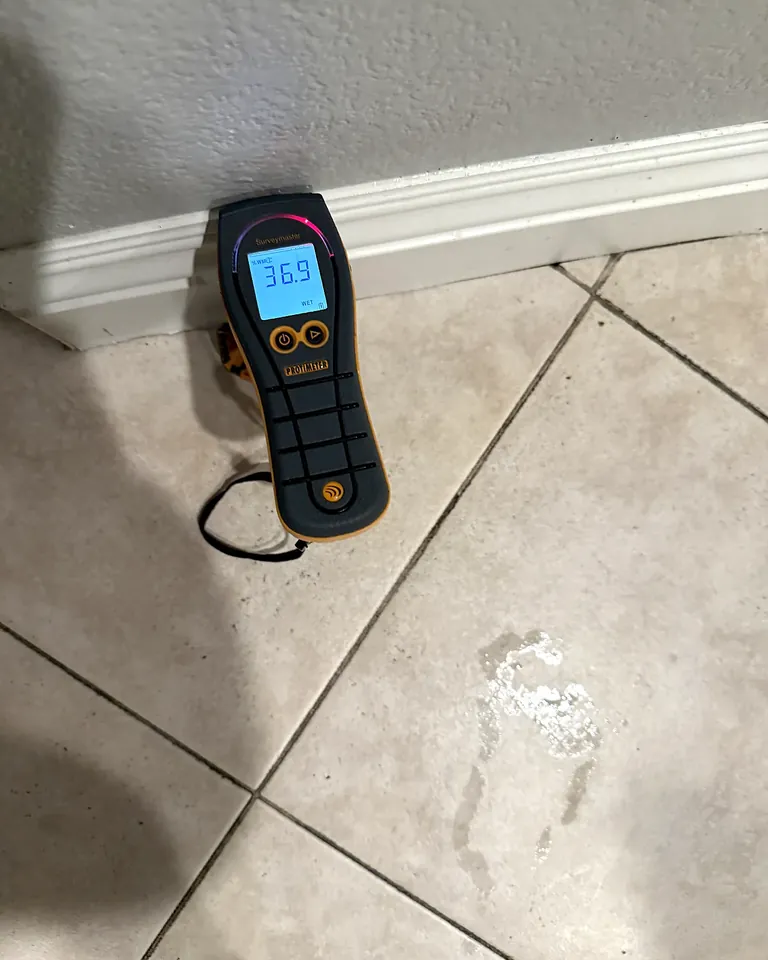
The same displayed number is not interchangeable across every instrument, setting, or material. The meter in this article's photo illustrates an inspection tool, not a recommended pass/fail value. A homeowner's surface check also does not replace an assessment of an inaccessible layer or the tests an installer needs for the chosen floor.
- Request a record of affected locations and the materials checked.
- Ask what evidence supports the drying goal and what remains untested.
- Discuss any readings or visible changes that stop improving rather than deciding the job is finished because equipment has run for several days.
Guidance references: [3] US EPA: Investigating and Evaluating Moisture Problems (Chapter 3)
4. Separate restoration drying from installation approval
A restoration drying record and permission to install a particular product answer related but different questions. Before covering the substrate, ask the flooring professional to identify the manufacturer's requirements for that flooring, underlayment, and adhesive, and the tests needed to evaluate the actual substrate. Obtain the relevant product instructions rather than relying on a generic online moisture percentage.
Clarify who will perform the installation checks, who will interpret the results, and what happens if the substrate does not meet the requirements. A flooring installer may need information beyond the restoration team's monitoring notes. Keep both sets of records together, but do not assume that a restoration invoice alone certifies readiness for every replacement product.
This checklist is general planning advice, not a quoted installation standard. Product requirements, substrate condition, contamination, damage, and access can change the scope. A responsible plan should explain these uncertainties rather than promise a fixed date before the floor has been assessed.
5. Do not use a drying deadline as a completion test
EPA recommends prompt action after clean-water damage and gives early-response guidance for affected materials. That is not a guarantee that a particular floor will be dry within 24 or 48 hours. EPA also cautions that its timing guidance is not an exact boundary for whether mold growth will occur.
A suitable drying plan may combine removal of accessible water, airflow, and dehumidification, with reassessment as materials change. EPA notes that wood surfaces need care when heat is used. Do not turn up heat or add fans without appropriate guidance to force a floor to match an installation appointment.
If the source is still uncertain, materials remain damaged, odors develop, or assessment reveals a contamination concern, pause the assumption that the next step is simply new flooring. Ask what additional investigation or specialist input is needed before the area is covered.
Guidance references: [1] US EPA: Table 1: Water Damage — Cleanup and Mold Prevention (clean water); [3] US EPA: Investigating and Evaluating Moisture Problems (Chapter 3)
6. Use a documented handoff before booking replacement
For a Costa Mesa property, the practical handoff is a clear explanation of what was affected, what was cleaned or removed, how drying was monitored, and what the flooring professional must still verify. A short written checklist is more useful than an unsupported statement that the floor looks fine.
If an insurance claim is involved, ask your insurer about documentation and inspection before discarding damaged materials or authorizing permanent repairs, subject to immediate safety needs. Keep safe photographs, receipts, and communications. Coverage, repair authorization, and reimbursement depend on the policy and circumstances; this guide does not promise payment.
- Source repair: what was corrected, by whom, and what remains uncertain?
- Affected materials: which layers were retained, removed, or inaccessible?
- Drying record: where were readings taken, and what supports the assessment?
- Installation checks: what does the selected product require, and who verifies it?
- Authorization: who approves the repair scope and the start of installation?
Guidance references: [4] California Department of Insurance: Residential Property Claims Guide
Sources and references
- US EPA: Table 1: Water Damage — Cleanup and Mold Prevention (clean water)
- OSHA: Flood Preparedness and Response — Response/Recovery
- US EPA: Investigating and Evaluating Moisture Problems (Chapter 3)
- California Department of Insurance: Residential Property Claims Guide
References support the cited safety and drying guidance. They do not endorse Flood-Pro, verify business credentials, or establish property-specific conditions or service coverage. Access, scheduling, and installation questions are planning advice; confirm applicable requirements with the responsible professionals.
Common questions
Can I replace flooring as soon as the surface feels dry?
Not on that observation alone. Underflooring or other affected layers may still need cleaning, drying, or assessment. Ask for the restoration findings and have the flooring professional confirm the installation requirements for the selected product.
What moisture reading means a water-damaged floor is ready?
There is no universal number for all floors. The material, test method, instrument, and flooring or adhesive requirements matter. Ask what was measured, how results were interpreted, and which installation checks remain necessary.
Does every wet floor in Costa Mesa need to be removed?
No. The water source, damage, materials, access to affected layers, and ability to clean and dry them influence that decision. Arrange assessment rather than assuming all flooring can stay or that every wet surface must be replaced.
Will two days of drying make the floor safe to cover?
A fixed duration does not prove readiness. EPA's early-response guidance is not a guarantee that every floor dries within 24 or 48 hours. Use documented assessment and the selected flooring system's installation requirements instead.